

Micro Invest 2026: A 65% Tax Credit on Your Website


If your business is paying for a new website, online shop or app in 2026, Malta’s Micro Invest scheme can give you back up to 65% of the eligible cost as a tax credit, or 85% if you operate from Gozo. Plenty of businesses that qualify never claim it, and plenty more lose it over one detail: the agreement for the work has to be signed before the work starts.
This guide explains, in plain English, what the 2026–2030 rules say about websites and digital projects, who can apply, how much you can get back and how to avoid the mistakes that sink a claim. It’s based on Malta Enterprise’s official Micro Invest 2026–2030 Incentive Guidelines (version 1.0, published 11 May 2026).
What is Micro Invest?
Micro Invest is a Malta Enterprise scheme that encourages small businesses, start-ups, family businesses, social enterprises and the self-employed to invest in their business. Instead of a cash grant, you receive a tax credit certificate: a percentage of what you spent, which you then use to reduce the income tax on your business profits.
The current version runs from 1 January 2026 and covers eligible costs incurred from that date. Malta Enterprise won’t award aid under these guidelines after 31 December 2030, so the same rules apply to investments you make over the next few years.
Who can apply?
The scheme is open to most Maltese businesses, as long as they meet these conditions at the time of applying:
- You employ at least one person (full-time or part-time) and no more than 50 full-time employees. Jobsplus records are used to check this.
- If you’re self-employed and registered with Jobsplus, you meet the minimum employment requirement yourself.
- You’re registered with the VAT department, unless you’re exempt.
- Your business isn’t in a sector excluded by the EU de minimis rules, such as primary agriculture and fisheries.
Does a website count?
Yes. The 2026–2030 guidelines list “Digital Solutions” as an eligible investment (section 4.2.3). That covers:
- Development and customisation of websites, software systems and digital applications, which includes online shops and mobile apps.
- Packaged software you buy for the business.
- Customising and setting up a software-as-a-service tool, including the first 12 months of its licence.
- Work that makes your website more accessible for people with disabilities, if it’s certified by the Foundation for Information Technology Accessibility (FITA).
- Maintenance and hosting that come with a new solution you’re claiming for.
What isn’t covered?
- Hosting, maintenance and subscription renewals that aren’t part of a new solution.
- Any invoice under €500 excluding VAT.
- VAT and import duties: these are deducted from the eligible amount.
- Costs that another public scheme has already paid for, in part or in full. For bigger software projects, that could be a Digitalise Your SME grant.
- Costs not directly related to your business.
How much can you get back?
The credit is a percentage of the eligible cost, up to a cap over any three-year period. For every €100 of eligible website development, you could receive up to €65 in tax credits, or €85 in Gozo.
| Your business | Tax credit | Cap over 3 years |
|---|---|---|
| Operating from Malta | Up to 65% | €65,000 |
| Operating from Gozo | Up to 85% | €85,000 |
| Registered family business | Up to 65% | €85,000 |
| Female-owned business | Up to 65% | €85,000 |
| Registered social enterprise | Up to 65% | €85,000 |
On top of that, the EU de minimis rules cap all de minimis aid to one business group at €300,000 over three years, counting other schemes too. Few small businesses come close, but it’s declared on the application.
How the tax credit works
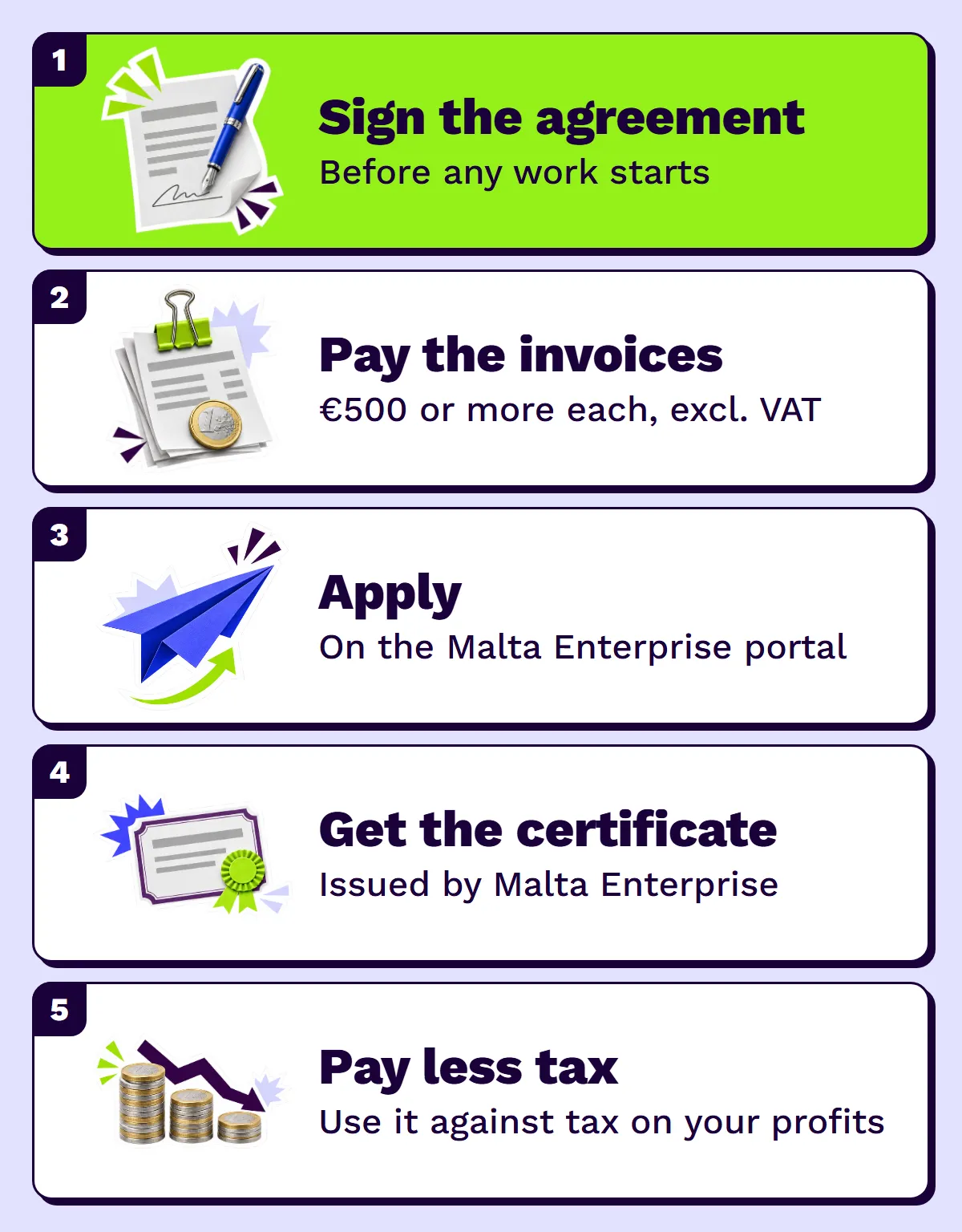
Malta Enterprise issues a tax credit certificate. You use it against the tax on profits from your business, up to the fifth year of assessment named on the certificate. It can’t be refunded as cash, used to settle tax arrears or transferred to another business, so it’s most useful if your business makes a taxable profit.
How to apply, step by step
- Agree the scope first. Get a written agreement that lists what the website or app will do, and sign it before any work starts.
- Keep the paperwork. A VAT tax invoice or fiscal receipt for each cost (at least €500 excluding VAT), plus proof of payment.
- Register on the Malta Enterprise client portal if you haven’t used it before.
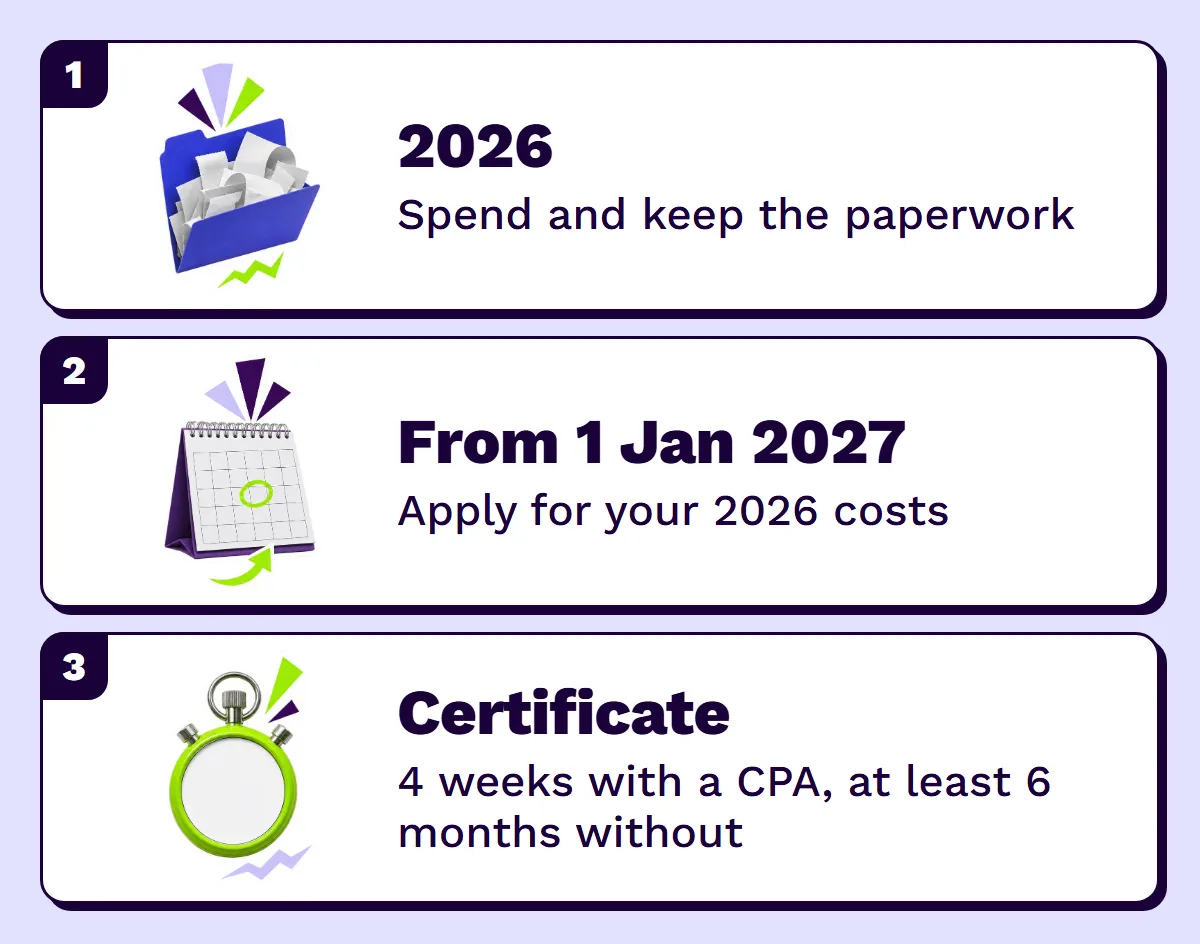
- Apply once a year. Applications for costs incurred in 2026 can be submitted from 1 January 2027, and one application can cover up to three years of costs not already claimed.
- Consider a CPA. Applications completed by a certified public accountant under the official technical guidance are processed within four weeks; others take at least six months.
- Keep everything for ten years after the certificate is issued, in case of an audit.
Mistakes that sink a claim
- Starting before signing. If the agreement is dated after the work began, the development costs don’t qualify.
- Vague quotes. The agreement has to specify the functionality, not just a total. Our guide to what affects the cost of a website shows what a clear quote lists.
- Small invoices. Invoices under €500 excluding VAT are ignored, so avoid splitting the project into lots of small bills.
- Claiming renewals. Next year’s hosting or licence renewal isn’t eligible on its own.
- Leaving it too late. Without a CPA, processing takes at least six months; if you need the certificate by November, apply by the end of May.
Micro Invest questions
 Didn't find your question?
Ask us directly. We reply within two working days, faster on WhatsApp.
Can self-employed people claim Micro Invest on a website?
Yes. A self-employed person registered with Jobsplus meets the minimum employment requirement, and website development counts as an eligible digital solution, as long as the other conditions are met.
Is an online shop eligible for Micro Invest?
An online shop is a website, so its development and customisation count under Digital Solutions. Hosting and maintenance only count when they come with the new shop, not as later renewals.
When can I apply for costs from 2026?
From 1 January 2027. You can submit one application a year, and each one can include costs from up to three previous calendar years that haven’t been claimed before.
Do I need an accountant to apply?
It isn’t required for investment costs, but applications completed by a CPA under the official technical guidance are processed within four weeks instead of six months. Claims on wage increases must be reviewed by a CPA.
Is the tax credit paid out in cash?
No. It reduces the income tax on your business profits, up to the fifth year of assessment on the certificate, and it can’t be refunded or transferred.
Sources
Malta Enterprise, Micro Invest 2026–2030 Incentive Guidelines, version 1.0, published 11 May 2026, and the Micro Invest 2026–2030 scheme page. Last checked 6 November 2026. This is a summary, not tax advice: rules can change, so check the latest guidelines with Malta Enterprise (Business First, 144) or your accountant before you rely on them.
Keep reading

What Is an AI Agent, and Does a Small Business Need One?

Digitalise Your SME: What Malta’s Grant Really Covers

Website Builder or Web Design Agency? How to Choose

Ready when you are.
Tell us what you need and we'll send a fixed quote.